Posts

Psalm 40

Image
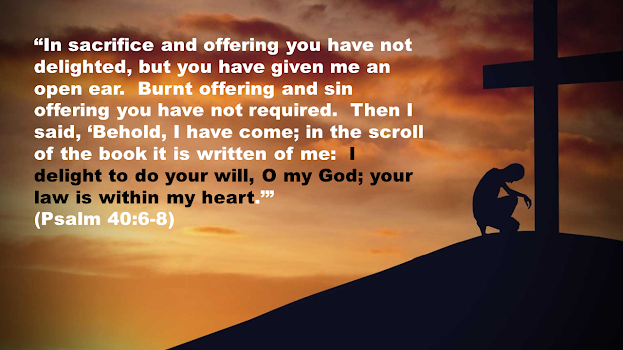
  In Psalm 40, David begins by giving thanks and praising God for His innumerable "wondrous deeds," which include hearing his prayers and delivering him from the pit.  Psalm 40:6-8 is quoted in Hebrews 10:5-7, referring to Christ's sacrifice once for all.  We are to praise God and share the good news of deliverance, so that "many will see and fear, and put their trust in the LORD" (vs 3b)  and all who seek the LORD will rejoice and be glad, saying continually "Great is the LORD!" (vs 16). Following are some reflections that may be beneficial to consider when meditating on this psalm: Verses 1-3 What can help me to be more PATIENT when waiting for the LORD to answer my prayers? How might the image in verse 2 of being lifted from the pit and muddy clay to be set on solid rock give me encouragement when I feel like I have fallen into a pit or am floundering? In verse 3, what are some benefits of taking time to give praise to God for every "new"...

Psalm 39

Image
  Psalm 39 is written by David for the Chief Musician.  Jeduthun, in the subtitle, was a Levite as seen in 1 Chronicles 9:16 and was likely a worship leader.  In this psalm, David vows to be silent through what he is suffering.  Yet when he could no longer stay silent, he cries out in prayer to the LORD.  He asks for perspective in light of how fleeting life is, and through his reflections, he recognizes that his hope should really be in the eternal God.  He sees that his suffering is due to the LORD's discipline and rebuke for sin.  Since this world is not his home, his closing prayer is that his relationship with God will be restored before he departs from this world for his home in heaven. Following are some reflections that may be beneficial to consider when meditating on this psalm: Verses 1-3 As he was going through suffering, David was afraid he might say something he shouldn't; so, he chose not to say anything at all, bad or good.  Why is ...

Psalm 38

Image
  Psalm 38 is another one of the Penitential Psalms (6, 32, 38, 51, 102, 130, 143).  David is in agony as he is convicted by his own sin and senses God's displeasure.  Sin has devastating effects in every aspect of life (e.g., spiritual, physical, mental, emotional, and relational).  The closing prayer is that the LORD will not forsake, but will instead save and deliver.  Following are some reflections that may be beneficial to consider when meditating on this psalm: Verses 1-2 What should be my perspective of sins in my life, especially when I recognize God's righteous anger against sin and His displeasure? Verses 3-20 What devastating effects can sin have in my life? The psalmist refers to God as "LORD" ( Yahweh - covenant LORD), "Lord" ( Adonai - Master), and "God" ( Elohim - mighty God) (e.g., in verses 15 and 21-22).  When dealing with our sins, why is it beneficial to consider the characteristics of God emphasized by these various references?...

Psalm 37

Image
  Psalm 37 is a wisdom psalm, carrying the theme of the righteous versus the wicked.  It is generally arranged in an acrostic using the letters of the Hebrew alphabet at the beginning of each sentence.  King David is older as he writes this psalm (vs 25), and he uses proverbs to teach wisdom based on his observations and experiences.  Rather than fret or be envious because of evildoers, the righteous can trust in the LORD, delight in the LORD, commit their way to the LORD, and be still before the LORD.  Ultimately, the wicked will be cut off and perish, but the LORD is a refuge and stronghold for the righteous in time of trouble. Following are some reflections that may be beneficial to consider when meditating on this psalm: Verses 1-2 To fret is to worry, become vexed, or get all worked up.  Why do I NOT need to fret or be envious? Verses 3-7 Rather than worry or envy, what do these verses say I should do instead? As I am trusting in the LORD (vs 3), what ...

Psalm 36

Image
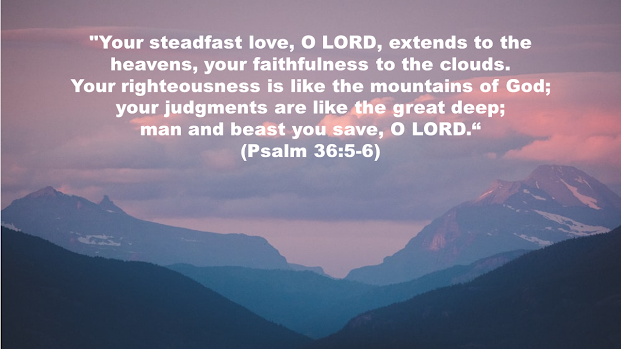
  Psalm 36 carries the common theme in Wisdom literature of the contrast between wickedness and righteousness.  At the center of the psalm is a focus on the steadfast love of the LORD that "extends to the heavens" and is immeasurable.  God's love, faithfulness, righteousness, and justice affects all creation.  He provides protection and abundant blessing; for He is the "fountain of life" and the light.  The psalm closes in prayer in response to the lovingkindness of God contrasted with the wickedness of man. Following are some reflections that may be beneficial to consider when meditating on this psalm: Verses 1-4 What do these verses tell us about the sinful nature of man?  (For example, verse 4 says that the wicked person "plots trouble while on his bed," indicating that they are continually plotting evil, not resting even when it is time to sleep) The Apostle Paul quotes Psalm 36:1b in Romans 3:18 as he describes the depravity of mankind, leading to...

Psalm 35

Image
  Psalm 35 is one of the Imprecatory Psalms (7, 35, 55, 58, 59, 69, 79, 109, 137, 139), praying for God's judgment and justice.  The psalm begins with David asking God to be his advocate against accusers and to be his deliverer against attacks from enemies.  Judgment against the wicked is a common theme in wisdom literature, reminding us of God's ultimate justice.  Our appropriate response is to rejoice and to praise the LORD. Following are some reflections that may be beneficial to consider when meditating on this psalm: Verses 1-3 In verse 1, contend , plead , argue or strive are legal terms.  What does it mean for me that Jesus is my Advocate against Satan the Accuser in a court where God is Judge? These verses pray for God not only to defend (i.e. " take hold of shield and buckler ") but also to take the offensive (i.e. " draw the spear and javelin ").  What battles am I fighting in which I need to remember that I don't have to fight them alone? Ve...

Psalm 34

Image
  Psalm 34 is also an acrostic, similar to Psalm 25, with each verse beginning with a letter in the Hebrew alphabet. The historical background of this psalm is narrated in 1 Samuel 21:10-15, when David pretended to be insane in order to escape from Abimelech at Gath.  In this psalm, David praises God, particularly for His deliverance.  We are encouraged to "taste and see that the LORD is good" (vs 8). Also consistent with wisdom literature, we are to fear the LORD and the live the life of the righteous, in contrast to the wicked. Following are some reflections that may be beneficial to consider when meditating on this psalm: Verses 1-3 What do these verses show me about praising, boasting in, magnifying, and exalting the LORD? (e.g. take into consideration the words like "continually," "humble," and "together") Verses 4-7 What do these verses show me about the LORD when I am facing troubles? These verses use various pronouns (e.g., I, me, their, ...